


Bishops But What Kind
Publisher: SPCK
Format: Paperback
ISBN: 0281038600
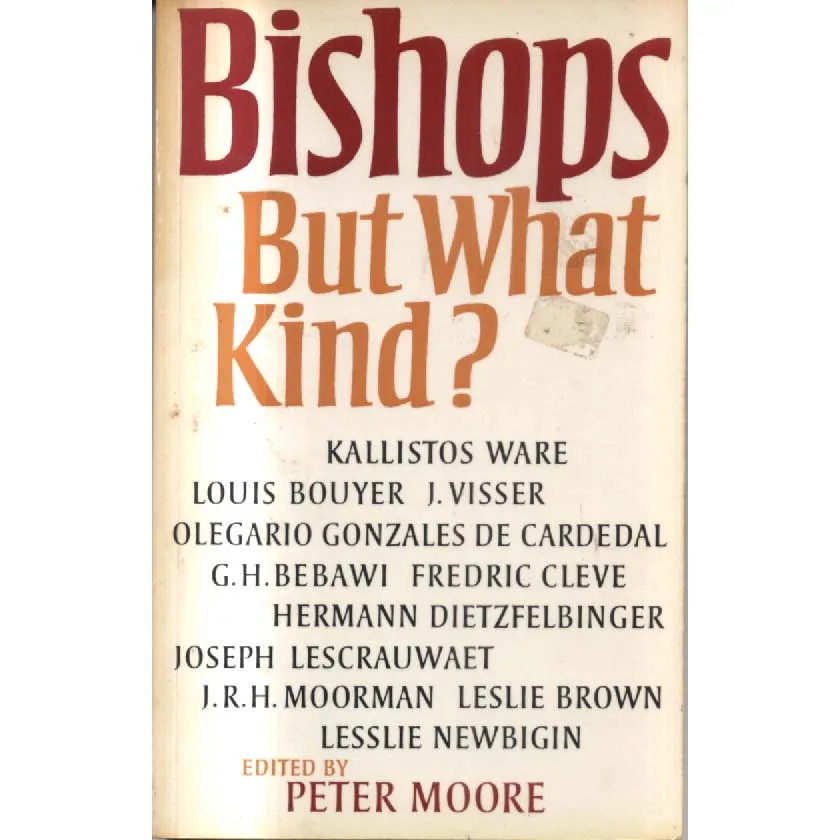
Bishops, But What Kind? (1982) edited by Peter Moore
SPCK
ISBN: 0281038600
Condition: Good
The title Bishops, But What Kind? has the air of a particularly specialised recruitment problem.
Bishops, yes.
But what sort?
Tall ones? Ancient ones? Administrative ones? Ceremonial ones? Ones who spend most of their time opening church halls and writing letters beginning “Dear Brothers and Sisters in Christ”?
Peter Moore’s 1982 volume is, fortunately, considerably more serious than that. This is a collection of reflections on episcopacy — the office, authority and role of bishops — drawn from different Christian traditions around the world at a time when questions of church unity were being taken very seriously indeed.
The central problem is straightforward enough.
Many churches agree that bishops matter.
The difficulty begins when somebody asks what exactly a bishop is supposed to be.
And Christianity, having spent nearly two thousand years developing several answers simultaneously, is not short of material.
Moore brings together contributors from a striking range of traditions, including Roman Catholic, Orthodox, Anglican, Lutheran, Old Catholic and Coptic backgrounds, as well as voices from different parts of Europe and Africa. The result is less a single answer than a theological conference conducted between two covers.
Which is probably appropriate.
Because the bishop, depending on whom you ask, may be a pastor, teacher, guardian of doctrine, symbol of unity, administrator, successor to the apostles, liturgical figure, church leader or person responsible for appearing at important occasions wearing particularly distinctive headgear.
Often several at once.
The book emerged during a period of intense ecumenical discussion, when churches with very different structures were exploring closer cooperation and even forms of reunion. One awkward question repeatedly appeared: if a united church is going to have bishops, what exactly are all the participants agreeing to?
This is not as trivial as it sounds.
A church that has maintained historic episcopacy for centuries may understand a bishop very differently from a church accustomed to ministers, presbyteries, synods or superintendents.
Simply changing the label on the office door does not necessarily solve the problem.
Hence this book.
The contributors examine how episcopacy operates in different traditions and contexts, looking at questions of authority, apostolic succession, leadership and the bishop’s relationship with clergy and laity.
There is even the slightly alarming possibility that churches may agree enthusiastically on the importance of bishops while meaning entirely different things by the word.
Theology does enjoy this sort of thing.
One contributor is the influential missionary theologian Lesslie Newbigin, writing on bishops in the context of a united church, while other essays examine episcopal traditions across Anglican, Lutheran, Orthodox and Catholic settings. The book therefore offers a useful cross-section of Christian thinking rather than presenting episcopacy as though everybody had settled the matter sometime around the fourth century and gone home.
They had not.
The historical dimension is particularly interesting.
Bishops are among Christianity’s oldest continuing institutions, yet the role has changed enormously according to time, place and denomination.
An early Christian bishop presiding over a local community would probably be mildly astonished to meet a modern diocesan bishop dealing with safeguarding procedures, budgets, property committees and approximately six thousand emails.
The theological continuity may be impressive.
The paperwork has clearly evolved.
The book also raises the broader question of what authority in a church is actually for.
Is a bishop primarily there to govern?
To preserve unity?
To teach?
To represent the church publicly?
To ensure continuity with historic Christianity?
Or merely to attend meetings until sanctification occurs naturally through exhaustion?
Different traditions provide different emphases, which makes this collection valuable for anyone interested in ecclesiology — the study of what the Church actually is and how it ought to organise itself.
Published by SPCK in 1982, Bishops, But What Kind? is very much a product of the ecumenical optimism of its period, when considerable energy was being invested in the possibility that Christian denominations might eventually overcome centuries of division.
Progress has perhaps been slower than anticipated.
Christians remain exceptionally talented at discovering theological distinctions.
Nevertheless, many of the questions discussed here remain relevant wherever churches debate leadership, authority and unity.
For students of Anglicanism, church history, ecumenism and Christian theology, this is an intriguing snapshot of serious discussions taking place across denominations in the early 1980s.
It is also exactly the sort of specialised theological title that may cause an innocent visitor to your bookshelf to pause briefly and wonder how deeply involved you have become in episcopal administration.
This copy is in Good condition, which is reassuring given that episcopacy itself has survived considerably longer and endured rather more disagreement.
Available from Crappy Old Books, where we have no bishops on staff, although somebody does occasionally have to exercise oversight.
Keep browsing: See more Religion books Other books by Peter Moore
